PDF Download HBR's 10 Must Reads on Teams (with featured article "The Discipline of Teams," by Jon R. Katzenbach and Douglas K. Smith)
When you have read it much more pages, you will recognize more and more again. Moreover when you have reviewed all finished. That's your time to constantly keep in mind and do what the lesson and experience of this publication offered to you. By this problem, you have to know that every publication ahs various way to present the perception to any kind of viewers. Yet they will certainly be as well as have to be. This is exactly what the DDD constantly provides you lesson about it.
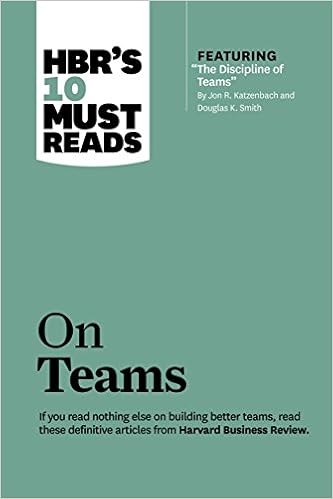
HBR's 10 Must Reads on Teams (with featured article "The Discipline of Teams," by Jon R. Katzenbach and Douglas K. Smith)

PDF Download HBR's 10 Must Reads on Teams (with featured article "The Discipline of Teams," by Jon R. Katzenbach and Douglas K. Smith)
After coming to be successful to end up reading a book, have you been enough? As a book fan, it will certainly not be enough to review guide. Continue and also proceed! This is just what you have to do to boost and also constantly establish the understanding. Bok is one that will certainly make you feel addicted. But, it remains in the positive term. Locate the books that will give positive enhancement for you now.
When a few other peoples still feel so tough to find this book, you may not face that trouble. Your way to utilize the web link and also participate in this site is right. You could discover the resource of guide as HBR's 10 Must Reads On Teams (with Featured Article "The Discipline Of Teams," By Jon R. Katzenbach And Douglas K. Smith) that will not go out whenever. For making wonderful problem, it turns into one of the ways that lead you to always make use of and also make use of the advanced modern technology.
This is not about just how much this publication HBR's 10 Must Reads On Teams (with Featured Article "The Discipline Of Teams," By Jon R. Katzenbach And Douglas K. Smith) expenses; it is not likewise for exactly what type of book you actually love to check out. It is about just what you can take as well as get from reviewing this HBR's 10 Must Reads On Teams (with Featured Article "The Discipline Of Teams," By Jon R. Katzenbach And Douglas K. Smith) You could choose to pick other book; but, it doesn't matter if you try to make this publication HBR's 10 Must Reads On Teams (with Featured Article "The Discipline Of Teams," By Jon R. Katzenbach And Douglas K. Smith) as your reading selection. You will certainly not regret it. This soft file book HBR's 10 Must Reads On Teams (with Featured Article "The Discipline Of Teams," By Jon R. Katzenbach And Douglas K. Smith) could be your buddy in any type of case.
If you still require a lot more publications HBR's 10 Must Reads On Teams (with Featured Article "The Discipline Of Teams," By Jon R. Katzenbach And Douglas K. Smith) as references, visiting look the title and also theme in this site is available. You will find more great deals books HBR's 10 Must Reads On Teams (with Featured Article "The Discipline Of Teams," By Jon R. Katzenbach And Douglas K. Smith) in various disciplines. You can likewise as soon as possible to read the book that is currently downloaded. Open it and save HBR's 10 Must Reads On Teams (with Featured Article "The Discipline Of Teams," By Jon R. Katzenbach And Douglas K. Smith) in your disk or device. It will reduce you wherever you need the book soft data to review. This HBR's 10 Must Reads On Teams (with Featured Article "The Discipline Of Teams," By Jon R. Katzenbach And Douglas K. Smith) soft documents to review can be reference for everybody to enhance the skill as well as capacity.
About the Author
Harvard Business Review is the leading destination for smart management thinking. Through its flagship magazine, 11 international licensed editions, books from Harvard Business Review Press, and digital content and tools published on HBR.org, Harvard Business Review provides professionals around the world with rigorous insights and best practices to lead themselves and their organizations more effectively and to make a positive impact.
Read more
Product details
Series: HBR's 10 Must Reads
Paperback: 208 pages
Publisher: Harvard Business Review Press (March 12, 2013)
Language: English
ISBN-10: 1422189872
ISBN-13: 978-1422189870
Product Dimensions:
5.5 x 0.8 x 8.2 inches
Shipping Weight: 8.5 ounces (View shipping rates and policies)
Average Customer Review:
3.9 out of 5 stars
19 customer reviews
Amazon Best Sellers Rank:
#51,777 in Books (See Top 100 in Books)
HBR’s 10 Must Reads on Teams gives the team leader a quick place to find down-to-earth articles containing much needed research into how teams operate, should be constructed and how they can be made more efficient. While I enjoyed reading the articles in the book, I was deeply interested in the first one, which I believe should catch the imagination of any technical-minded leader, “The New Science of Building Great Teamsâ€. Starting the book of with such a well-written and researched article is certainly powerful.Until I read this article, I wondered if there was a way to follow and track the social interactions of team members to see what skills were most important to building a good team. Pentland was able to build such a device: a wearable badge that collects data on “what tone of voice they use; whether they face one another; how much they gesture; how much they talk, listen, and interrupt; and even their levels of extroversion and empathy. By comparing data gathered from all the individuals on a team with performance data, we can identify the communication patterns that make for successful teamwork†(Pentland as cited in HBR's 10 Must Reads On teams, p.5, 2013). This research shows that face-to-face interactions are more important than emails, phone calls, voicemails or texts. While I like emails for data-trails, I would rather discuss issues and ideas in person, so I am pleased to learn how teams can be at least 8% more effective by adding more face time (2013).Pentland’s research shows that successful teams share several defining characteristics: team members talk and listen equally, members face one another with energetic conversations and gestures, members interconnect, members carry-on side conversations, and members get information from outside the team periodically (2013). These characteristics are boiled down into three elements of communication: energy, engagement and exploration. Energy comes from the number and nature of interactions between team members with the most valuable being face-to-face exchanges (2013). Video or voice calls are next in line of importance, but the value decreases from face time. The research shows that even in our technological world, sitting down to have a conversation with the person across from you is the best interaction you can have. The engagement element comes from the “distribution of energy among the team members†(p. 7, 2013) which means that all the team members have equal and high energy as they interact. The exploration element stems from the amount of interactions team members have with individuals and teams outside of their own team (2013). I believe these three elements are easily remembered and applicable.Pentland is able to show through data collection how a company can be very inefficient in its communication until a problem arises and then it will switch to face-to-face communication to solve the problem (2013). This shows that the problem may have been avoided if the teams would have communicated in this fashion from the start. The issue with this type of communication over email, text, social media or voicemail, is that it needs more investment. Time to schedule, plan and have such interactions are hard to accomplish at times in our fast-paced business world. However, when crucial issues arise or are expected to arise, we need to make the time to plan these meetings.I enjoyed the diagrams of social interactions the article contained, especially the ones showing the progression of the project and the problems it caused. Knowing that the different departments of a company did not speak directly, but instead relied on electronic media, failed in their product roll-out but had to fix it with direct verbal communication is extremely powerful and important for team leaders and executives. It should be enough to make leaders change how teams are constructed and how they communicate.
Avoiding Dictator Syndrome: The Paradox of Circular Logic in TeamsIn HBR’s 10 Must Reads On Teams (2013), I have found Frisch’s (2008) article, When Teams Can’t Decide, to be my favorite and most applicable to my current career season. In my career, I’m considered one of three core discipline leads, whose work impacts the other in a circular fashion. When having team meetings to discuss creating new features, each lead, representing the expertise of their team’s function, weighs in on the conversation. This often presents the issue of what Frisch has identified as “circular logic†(Strategic…, 2012). Circular logic, also known as the “voting paradoxâ€, was first discovered by an eighteenth century French mathematician and social theorist, the Marquis de Condorcet, in which “… different subsets of the group can generate conflicting majorities for all possible alternatives†(Frisch, 2008, loc. 2144). The article focuses on how teams can circumvent the “dictator-by-default syndromeâ€, which is cornering their superior to make an either/or decision, and navigate the complexities of circular logic (Frisch, 2008). The purpose of this paper is to review Frisch’s (2008) article.“The test of a first-rate intelligence is the ability to hold two opposed ideas in the mind at the same time, and still retain the ability to function†(Fitzgerald, 1945). In math, the transitive principle is stated as follows: if A > B and B > C, than A > C. However, the Marquis de Condorcet proved this principle is only true as an individual or in pairs (Strategic…, 2012). The transitive principle never became a law because it does not work for groups in which there are three or more decisions, each offering multiple options (Strategic…, 2012). What is perceived as irrational within the context of individuals and pairs is normal for groups and thus, no voting mechanism can overcome Condorcet’s paradox in a group (Strategic…, 2012). In applying this to my career, team members often approach a superior to help overcome decision-making logic because team members are more biased towards their functional areas. This produces a stalemate of sorts by not having the ability to rank preferences to decisions and enabling circular logic. Because information is presented to the superior as an either/or problem, it places them in a lose-lose situation. If A is selected, B and C lose, thus not favoring their superior’s decision. Is it possible the information can be nuanced and presented as a both/and? Spanier (n.d.) noted,Instead of being oppressed by the tyranny of the OR, highly visionary companies liberate themselves with the genius of the AND, the ability to embrace both extremes of a number of dimensions at the same time. Instead of choosing between A OR B, they figure out a way to have both A AND B. In order to circumvent “dictator-by-default syndromeâ€, and cater more towards having both A AND B, Frisch (2008) provided four suggestions: 1) specify the desired outcome, 2) test fences and walls, 3) surface preferences early, and 4) assign devil’s advocates (loc. 2168-2193). By focusing on the overall goal, the superior is able to narrow down the amount of options to what clearly achieves the goal (Frisch, 2008, loc. 2168). Frisch (2008) stated, “Without clear desired outcomes, team members choose options based on unspoken, differing assumptions. This sets the stage for the dictator-by-default syndrome†(loc. 2168). With clear direction on the goal, team members can now test their options against company policy to see if their ideas are stopped, a wall, or presented a passable barrier, a fence (Frisch, 2008, loc. 2193). Once passed, the options must be filtered based on the customer or stakeholder’s preferences (Frisch, 2008, loc. 2193). “Using weighted preferences is another way to narrow the decision-making field and help prevent the dictator-by-default syndrome†(Frisch, 2008, loc. 2259). The remaining options can be deliberated over until a final solution emerges. Frisch (2008) stated, “By breaking the false binary of a business case into several explicit and implicit alternatives and assigning a devil’s advocate to critique each option, you can depersonalize the discussion, making thorough and dispassionate counterarguments an expected part of strategic deliberations†(loc. 2280). In conclusion, Frisch’s (2008) article, When Teams Can’t Decide, focuses on how to work within the complexities of circular logic in decision-making and circumventing “dictator-by-default syndromeâ€. Frisch’s (2008) concepts to narrowing options for decision-making focuses on achieving the overall goal by not cornering a superior to an either/or decision, but enabling a both/and decision. The remaining options are then deliberated over until a final decision emerges.ReferencesFitzgerald, F. S. (1945). The crack-up. New York, NY: New Directions Publishing Corporation.Frisch, B. (2008). When teams can’t decide [Kindle]. In HBR’s 10 must reads on teams(loc. 2129-2344). Boston, MA: Harvard School of Publishing.HBR’s 10 must reads on teams [Kindle]. (2013). Harvard Business Review. Boston, MA:Harvard School of Publishing.Spainer, N. (n.d.). Excerpts from The Tyranny of the “OR†vs the Genius of the “ANDâ€.Strategic Offsite Group, Inc. (2012). Bob frisch on why teams can’t decide [video file].Retrieved from [...]
HBR's 10 Must Reads on Teams (with featured article "The Discipline of Teams," by Jon R. Katzenbach and Douglas K. Smith) PDF
HBR's 10 Must Reads on Teams (with featured article "The Discipline of Teams," by Jon R. Katzenbach and Douglas K. Smith) EPub
HBR's 10 Must Reads on Teams (with featured article "The Discipline of Teams," by Jon R. Katzenbach and Douglas K. Smith) Doc
HBR's 10 Must Reads on Teams (with featured article "The Discipline of Teams," by Jon R. Katzenbach and Douglas K. Smith) iBooks
HBR's 10 Must Reads on Teams (with featured article "The Discipline of Teams," by Jon R. Katzenbach and Douglas K. Smith) rtf
HBR's 10 Must Reads on Teams (with featured article "The Discipline of Teams," by Jon R. Katzenbach and Douglas K. Smith) Mobipocket
HBR's 10 Must Reads on Teams (with featured article "The Discipline of Teams," by Jon R. Katzenbach and Douglas K. Smith) Kindle
HBR's 10 Must Reads on Teams (with featured article "The Discipline of Teams," by Jon R. Katzenbach and Douglas K. Smith) PDF
HBR's 10 Must Reads on Teams (with featured article "The Discipline of Teams," by Jon R. Katzenbach and Douglas K. Smith) PDF
HBR's 10 Must Reads on Teams (with featured article "The Discipline of Teams," by Jon R. Katzenbach and Douglas K. Smith) PDF
HBR's 10 Must Reads on Teams (with featured article "The Discipline of Teams," by Jon R. Katzenbach and Douglas K. Smith) PDF

This post was written by: Author Name
Your description comes here!

Posting Komentar